How to Create Merch That Sells: A Production Guide for Brands, Artists, and Creators
How brands, artists and creators develop merchandise that sells through better products, custom cut-and-sew, sampling and full-package production.


How to Create Merch That Sells: A Production Guide for Brands, Artists, and Creators
3 MINUTES
November 11, 2026
The tour is booked, the campaign is taking shape, or your audience keeps asking when the merch will drop. Now it is your job to make it happen. You want the hoodie fans buy at the show and keep wearing afterward, the jacket that makes someone ask where it came from, and a collection that feels like it could only have come from your brand. You also need it ready before the moment passes.
The graphic is only part of that job. Fit, fabric, color, construction and finishing turn a piece of merchandise into something people actually want in their wardrobe. A full-package apparel partner develops that product with you, from original cut-and-sew concepts through samples, production and agreed delivery. You bring the brand, the audience and the direction; the apparel team handles the garment work and brings the decisions back to you for approval. This guide covers what to make, how to develop it, and how to get it into your customers' hands.
Treat merchandise as a product line from the start
Merchandise gives your audience something to buy beyond the ticket, subscription, or core product that brought them to you. It also puts your identity into everyday use, through clothing people choose to wear outside your event or campaign. Those commercial and brand roles deserve a budget, an owner, and a plan. A popular artist or recognizable logo still needs a garment that earns its price.
Merch can become meaningful commerce for businesses outside apparel, too. In January 2022, Modern Retail reported that Liquid Death's CEO attributed $3 million in 2021 revenue to merchandise, across a range that included non-apparel products. That historical result illustrates the business opportunity, not a sales forecast for your collection. Plan your own program around audience demand, product quality, and the costs of serving customers.
What to bring to your first apparel partner call
Start with context rather than technical instructions. Explain who buys from you, what they already wear, and whether the merchandise supports a tour, festival, brand campaign, creator launch, or recurring store. Bring brand assets, visual references, and examples of garments you like. Describe what attracts you to each reference, such as the relaxed shape, fabric feel, pocket layout, or restrained branding.
Share your working budget, intended retail prices, quantity expectations, and delivery destination. Distinguish a confirmed event date from a flexible ecommerce launch, and disclose any licensing or artist approval requirements. Previous sales by product and size are useful if you have them. If you do not, ask the partner to propose an assortment and size allocation for discussion rather than pretending your team already knows the answer.
Use the conversation to establish responsibilities. Ask who develops designs, coordinates samples, communicates revisions, manages production, and arranges shipping or fulfillment. Request a proposal that connects scope, development costs, product costs, order requirements, and approval milestones. You need a clear route from your brief to delivery, not just a price for an unspecified garment.
Choose products around how your audience will wear them
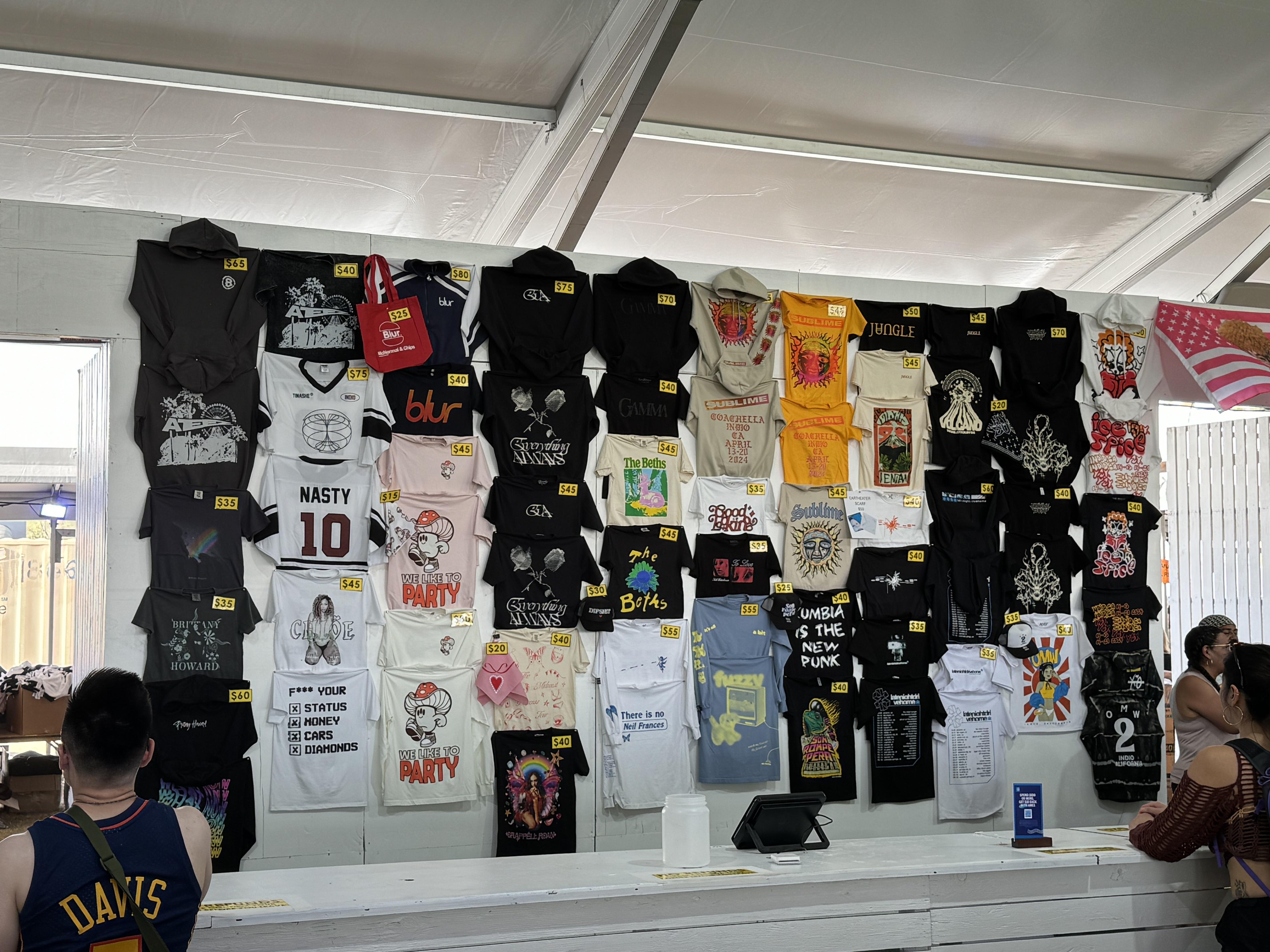
Build an assortment in which each product has a purpose. Consider the venue climate, your audience's wardrobe, how customers shop, and the amount they are comfortable spending. A festival table and a creator's online store do not require identical collections. Start with products you can explain and support, rather than filling every possible category.
Custom T-shirts
A custom tee can provide a straightforward entry into the collection without feeling disposable. Develop the silhouette, fabric, neckline, and graphic together so the result matches how your audience dresses. Tour artwork, an album reference, or a creator's visual language can carry the design, but the garment still needs comfortable proportions. Price it as a considered everyday product, with quality buyers can recognize.
Hoodies and sweatshirts
Hoodies give you room to build a more substantial product through fabric feel, shape, hood construction, and branding. They suit audiences who already wear fleece and launches where weather supports layering. Show the partner whether you want a compact everyday fit or a roomier silhouette. The added spend should buy a better wearing experience, not merely more decoration.
Jerseys and jackets
A custom jersey can connect with sports, gaming, music, or team identity through panels, color, numbering, and fit. Jackets offer a different role, with useful pockets, lining, closures, and a silhouette that extends beyond the event. Either can serve as the collection's more distinctive piece when the audience and budget support it. Develop them because they belong in the buyer's wardrobe, not because every merch program needs a premium item.
Headwear
Headwear adds an accessory option for customers who prefer a cap to another garment. Shape, crown depth, closure, fabric, and embroidery all affect whether it becomes something they wear regularly. Ask your partner to present a style that complements the apparel rather than treating hats as an automatic add-on. Fewer sizing variations do not remove the need to review fit and comfort.
Develop the garment and the branding together
Fully custom cut-and-sew merchandise starts with the garment itself, not a finished product awaiting a logo. Your partner develops its shape, fabric, fit, construction, and details around your brief, then coordinates the technical work needed to make it. You review concepts and material recommendations as a brand buyer. The development team turns your choices into patterns, specifications, and factory instructions.

Branding should support that design. Screen printing can carry bold artwork, embroidery can give a mark texture, and patches or appliqué can create a distinct surface detail. Panel graphics, contrast stitching, woven labels, and custom trims offer other ways to express the brand. Your partner should explain suitable methods, demonstrate the proposed result, and account for how each treatment behaves on the chosen fabric.
Retail-quality merchandise feels resolved as a whole product. Assess whether the fabric suits the season, the garment moves comfortably, the seams feel clean, and the branding looks intentional. Ask the partner how they evaluate laundering, dimensional changes, and decoration durability for the proposed design. Heavier fabric or more embellishment alone does not make a better garment.
Set a price the product can support
Decide the intended retail position while the collection is still taking shape. Your partner needs that context to recommend materials and details that fit both the wearer and the commercial plan. Compare your concept with products your audience already buys, paying attention to construction, usefulness, and presentation. A price needs a product behind it, not just an enthusiastic audience.
Liquid Death's Chop Shop Mechanic Jacket provides a concrete example from a beverage brand: its US product page lists a $74.00 jacket with heavyweight cotton twill, light insulation, and a quilted nylon taffeta lining. The design includes multiple pockets, embroidered front and back graphics, and adjustable cuff and hem tabs. Those features give shoppers something tangible to evaluate alongside the brand identity. Use the listing as a product-and-price reference, not evidence of how it was manufactured or how quickly it sold.
Check the economics beyond the production quote. Include development, packaging, freight, applicable duties, selling fees, fulfillment, and the allowances your program needs for returns or remaining inventory. Tour and festival selling arrangements can introduce additional costs that your team must confirm. If the intended price cannot support the finished product and its selling costs, revise the collection before approving bulk production.
Build the schedule backward from delivery
Start with the date and location where usable merchandise must arrive. For a tour, that could be a consolidation warehouse rather than the opening venue; for a festival, receiving arrangements can precede the public event. Ask the partner to build a calendar backward from that requirement. A production completion date is not the same as product in hand.
Separate creative decisions and sample revisions from the stages that follow approval. The agreed plan should cover approval of the final sample and production materials, material readiness, bulk manufacturing, quality checks, finishing, freight, and delivery. Your partner should explain which stages depend on earlier decisions and where the schedule allows for corrections. Original garment development requires its own plan, not a turnaround borrowed from decorating ready-made stock.
Assign one person to consolidate feedback and secure approvals from brand, artist, label, finance, or licensing stakeholders. Confirm the deadlines for those decisions before announcing availability. Changes to fabric, fit, artwork, quantities, or destination can change the production route and delivery date. Ask for the revised calendar whenever the scope changes, rather than assuming the original promise still applies.
Approve the physical sample before committing to bulk
A rendering helps you choose a direction, but a sample lets you evaluate the product your audience will wear. Review it on a person, handle the fabric, and check the garment from more than one angle. Consider collar comfort, sleeve length, body proportions, pocket usability, and the relationship between the artwork and the garment. Include the stakeholders whose approval will otherwise arrive late.

Give feedback in plain language and keep it consolidated. “The collar feels stiff,” “the body is too short,” or “the back graphic dominates the jacket” gives the development team a clear problem to solve. They should translate that feedback into technical corrections and explain what the next sample will confirm. The apparel sampling process provides more detail on how those review stages connect.
Before approval, ask what the sample represents and which elements remain provisional. Confirm final fabric, color, fit, branding, labels, and any outstanding changes through the partner's approval process. Keep a clear record of the approved version so production does not follow an outdated file or comment. Sample approval establishes the reference for bulk quality control; it does not replace those checks.
Prevent the production mistakes that create leftover inventory
Late planning and skipped sampling often compound each other. A team starts near the launch, discovers the schedule is tight, and removes the review stage that would reveal a problem. Begin the apparel conversation when the campaign or event becomes concrete. If the proposed collection cannot fit the deadline, work with the partner on feasible scope before committing to public promises.
An unfocused assortment spreads money across too many styles and colorways before demand justifies them. Give each product a clear customer, use, and price role, and remove options that repeat another item's job. Apply the same discipline to size planning. Use previous orders, size-specific sellouts, exchanges, and audience feedback where available, with the partner helping shape the proposed allocation.
Vague distribution responsibility creates a different kind of failure: finished goods that nobody has arranged to receive or sell. Identify who owns venue deliveries, warehouse intake, ecommerce inventory, customer orders, and returns before production starts. Put those responsibilities into the agreed scope. A manufacturer, freight provider, and fulfillment operator can each do their own job correctly while an unassigned handoff still delays your launch.
Plan finishing and distribution as part of the order
Finished merchandise needs to arrive in a form your selling team can use. Confirm labeling, folding, packaging, carton identification, and any barcode or size-sticker requirements with the receiving warehouse or event operator. Your apparel partner should translate those requirements into an agreed finishing plan. Do not wait until garments are complete to discover how the stock needs organizing.

For a tour or festival, clarify how stock moves between destinations and who authorizes replenishment. For ecommerce, establish who receives inventory, lists available sizes, packs orders, and handles exchanges. These are different workflows, even when they share the same garments. The festival apparel operations guide explores the coordination behind larger event programs.
Confirm the freight route, delivery terms, receiving contact, and status updates your team will receive. Full-package partners offer different logistics and distribution services, so ask what the proposal actually includes. Agree who handles exceptions such as a changed receiving window or an incomplete shipment. Clear handoffs protect the work already invested in the product.
Use the launch to inform ecommerce and reorders
Plan the collection's life after the event without assuming every product deserves extra inventory. Decide which designs remain available online, which are genuinely event-specific, and how unsold stock returns to the selling system. Prepare product photography, fit information, and descriptions from the approved merchandise. Customers shopping later need enough information to choose confidently without handling the garment.
Track demand by style, color, and size, alongside returns and customer comments. A sold-out size and a slow-selling color tell you more than total revenue alone. Review that information with your partner before the next production commitment, and confirm material availability and timing for any repeat order. Reorder because the evidence supports it, not because the original launch generated attention.
Make the next collection easier to produce
A useful merch program leaves your team with more than delivered cartons. It leaves approved product references, a clearer understanding of your buyers, and a production relationship that can support the next tour, campaign, or release. Keep your team's attention on direction and commercial decisions. Let the apparel team manage the specialist execution.
HH works as that outside apparel team for brands that need original products without building an internal department. Its studio brings together creative, manufacturing, and distribution capabilities, including custom apparel production work in Bangladesh, with responsibilities defined for each project. If you have an audience, a recurring merchandise need, and a launch to plan, bring your brief to a first conversation. Start with the product your customer should want to wear.
Frequently asked questions
How do you make merch that sells?
Develop merchandise around your audience's wardrobe, intended use, and willingness to pay, then validate the product through sampling. Pair a focused assortment with clear pricing, realistic delivery planning, and a workable selling channel. Use actual sales and customer feedback to improve subsequent orders rather than assuming recognition guarantees demand.
What merchandise products should we make first?
Start with a focused selection that matches how your audience dresses and where you will sell. Custom tees, fleece, jerseys, jackets, and headwear each offer different wearing and price roles. Ask your partner to recommend the strongest starting assortment within your budget instead of launching every category at once.
What does a full-package merch partner do?
A full-package merch partner develops the product and coordinates its path through design, materials, technical development, sampling, and manufacturing. The scope should specify quality control, finishing, freight, and any distribution services. Your team provides brand direction, commercial context, consolidated feedback, and approvals.
Do we need a finished design or tech pack to start?
No, you can begin with brand assets, inspiration, audience information, product ambitions, and practical constraints. A development partner turns that direction into garment concepts and the technical documentation needed for production. Agree who owns design development and approval before the project begins.
How long does custom merchandise production take?
Custom merchandise timing depends on product complexity, materials, sampling revisions, order scope, and the delivery route. Ask for a project-specific calendar covering approvals, material readiness, bulk production, quality checks, finishing, freight, and receipt. Confirm that the schedule meets your in-hands date before committing to a launch.
What are the benefits of custom cut-and-sew over decorated products?
Custom cut-and-sew gives you control over the garment's silhouette, fabric, fit, construction, and branding rather than only adding artwork to a finished item. That lets you develop a product around your audience and intended retail position. It also requires a development and sampling plan appropriate to the garment.
What should we check before approving a merch sample?
Check fit, comfort, fabric feel, color, construction, branding placement, and useful details such as pockets and closures. Confirm which elements are final and resolve outstanding revisions with the development team. Record approval against an identified sample version so bulk production follows the agreed product.
Can our team outsource merch without an internal apparel department?
Yes, a full-package partner can provide the apparel development and production capability your team lacks. You still need an internal owner for budget, brand direction, stakeholder feedback, approvals, and the selling plan. Define the partner's scope and distribution handoffs so outsourcing does not leave essential work unassigned.