Fitness Apparel Design: Darc Sport’s Community Playbook
A Darc Sport case analysis on building fitness apparel as a community system through product platforms, drops, and owning a unique look in the space.

Fitness Apparel Design: Darc Sport’s Community Playbook
3 MINUTES
August 27, 2026
The fitness brand that wants to sell more apparel is usually staring at the wrong problem. It thinks it needs a harder graphic, a bigger creator, or another seasonal colorway. Then it launches a T-shirt, a hoodie, and a pair of leggings with the logo in the usual places. The product gets likes. The customer gets another thing to wear. Nobody gets a reason to care.
Darc Sport presents the opposite model. Its apparel works as a marker of membership because the clothing carries a repeated cultural code, a stable group of recognizable silhouettes, and a steady drumbeat of named worlds that give customers a reason to show up again. A Darc Sport buyer is not only selecting black gym clothing. They are selecting a visible signal of the Wolves identity and the Never Fucking Give Up, or NFGU, ethos that Michael Civil has articulated in public.
This is the fitness-apparel lesson worth stealing. Your community does not become loyal because you print its slogan on a generic garment. It becomes loyal when the garment itself behaves like a piece of the community. Fit, material, finish, graphic scale, drop rhythm, and product hierarchy all reinforce the same story. The apparel turns the customer from an observer into a participant.
How Do You Build Fitness Apparel That Creates Real Community?
You build fitness apparel that creates community by developing a small set of recognizable product platforms, then using color, graphics, athlete content, release worlds, and limited drops to give those platforms meaning. The platform earns repeat purchase because the customer trusts the fit and hand feel. The story earns attention because it makes the product feel connected to a real training culture.
Darc Sport’s current product universe makes this visible. The live site separates menswear, the women’s She line, accessories, story and events, collectibles, and DSDD. The men’s catalog currently lists 268 products, while the She catalog lists 218. That is real assortment depth. Yet the system stays legible because the brand repeats a set of product families, including premium oversized tees, box-cut and raw-hem variations, fleece, named women’s bra and tank blocks, and named collection worlds such as Fighters Den.
The operative word is system. A fitness brand does not need to build 486 unrelated SKUs. It needs to decide which garments form the uniform, which pieces create the premium step-up, which technical categories deserve their own development discipline, and which releases have enough cultural tension to become a moment. Darc Sport demonstrates the power of that logic in public. Your job is to translate it into a product platform that belongs to your own customer.
The Brand System Behind the Assortment
Darc Sport was established in 2015 as an offshoot of Civil Regime, and it began with a clear bodybuilding orientation. Stab Mag described the company as “by bodybuilders for bodybuilders,” then chronicled expansion into other action and training communities, including MMA and surfing. That background matters because the brand did not start by trying to appeal to every active person on the internet. It began inside a defined culture with a hard-edged visual language, a shared relationship to training, and a phrase that could carry emotional weight beyond the gym.
“We highlight the grit before the glory, the struggle before success, letting our actions make the noise. It’s not WHO wears it… but WHY. It’s not for everyone… it’s for US. Wolves Forever.” Michael Civil, quoted by Stab Mag
That quote is the brand brief in plain language. It gives the customer a worldview, defines an insider group, and makes the clothing the evidence of that worldview. Darc Sport’s current About page still steers its audience toward “upcoming drops, athlete features, training content and an inside look at the Wolves.” In other words, the brand does not position the product as a passive commodity. It positions it inside a living content and community system.
The brand’s own story archive reinforces this behavior. Its site maintains named release pages spanning Rather Die Standing, Heaven Has To Wait, Ohana, Bushido, Corazon, Until Valhalla, Bury Me in Darc, Harley-Davidson, and For the Sake of Others across several years. The words change. The product grammar does not. The best fitness brands understand that distinction: cultural energy needs renewal, while product trust needs continuity.
The Product Architecture: What the Fitness Line Is Actually Selling
Darc Sport is selling more than a logo or a licensed graphic. It is selling a price ladder, a family of expected fits, and a way to move from ordinary training days to more expressive moments. The following inventory captures the live product system, not a claim about total unit volume, best sellers, or financial performance.
Product role | Current evidence | Price | Product and customer job |
|---|---|---|---|
Core men’s uniform | Relentless Beast Premium Oversized Tee in Slate Gray, described as tight-knit 100% cotton, sulfur washed, and screen printed. [7] | $50 | A familiar pump-cover and everyday training layer that makes the brand legible at a relatively accessible price. |
Silhouette extension | Current menswear includes premium oversized tees, box-cut tees, grunge raw-hem tees, muscle tees, hoodies, crewnecks, shorts, pants, jerseys, footwear, and accessories. [3] | Varies | Creates variation without abandoning the core fitness-lifestyle vocabulary. |
Fleece step-up | Our Code Chambers Zip Hoodie in Black, described as 100% cotton French terry with oversized chest and sleeves, true-to-size length, a pre-shrunk dyed vintage finish, screen print, and a drawcord hood. [8] | $70 | Gives the customer a colder-weather, higher-attention layer while continuing the oversized training silhouette. |
Women’s technical platform | Dual Wolf Everson Seamless Sports Bra in Purple Sky, described as a nylon-spandex blend with engineered side-knit detail, heat-transfer print, adjustability, and true-to-size fit. [9] | $50 | Establishes a separate technical apparel system with performance and fit expectations that differ from men’s cotton tops. |
Themed collection world | Fighters Den lists 62 products spanning original Darc items, entertainment and martial-arts licenses, tees, muscle tees, hoodies, shorts, bags, and $200 tee box sets. [10] | $40–$200 | Gives enthusiasts a collector-level reason to enter a specific story world without making every product a permanent core SKU. |
Retail edit | Pacsun’s July 2026 Darc Sport Athletics launch included 48 men’s and women’s pieces across tees, hoodies, shorts, pants, leggings, bralettes, and accessories. [11] | $40–$70 | Shows how the product language can be edited for a first retail partner without discarding fitness and streetwear crossover. |
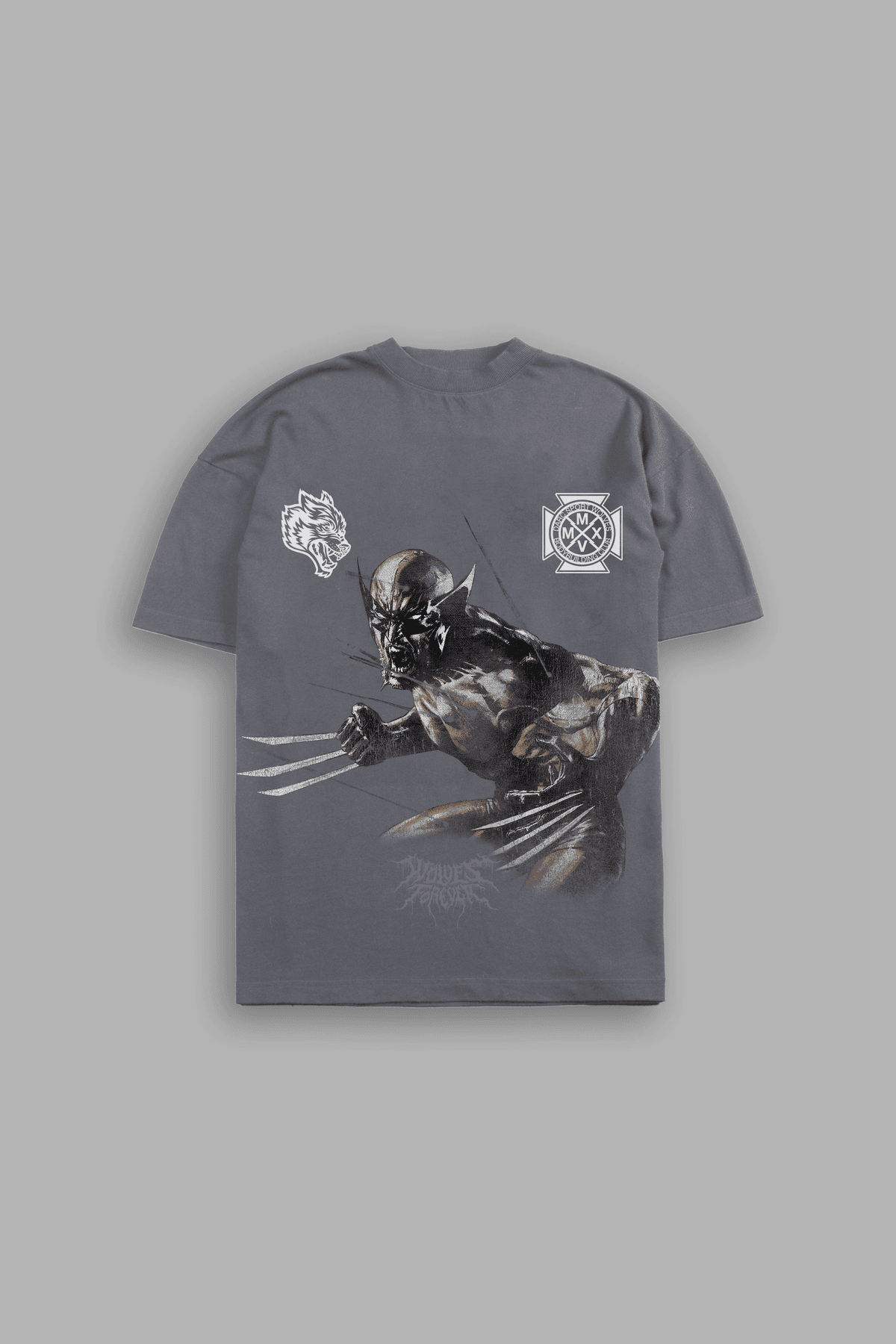
Darc Sport product image shown for editorial analysis. Source: Darc Sport, “Relentless Beast Premium Oversized Tee in Slate Gray”, accessed August 28, 2026.
The current menswear catalog holds a heavy concentration of tees at $45 to $55. That is not a trivial detail. The brand has a repeatable entry and replenishment layer that lets a customer buy into the visual world without making a large financial commitment. The hoodie then provides a controlled step up. The collector box set and licensed releases create a more elevated edge. That price ladder lets the brand serve the fan who wants a uniform, the buyer who wants a special piece, and the person who wants a giftable set.
The women’s line deserves separate attention. Its live catalog uses named systems such as Everson Seamless, Maya Soft Seamless, Soto Energy, Layla Soft Seamless, and Hannah Soft Seamless across bras, tanks, and other categories. That is how a fitness business stops treating women’s product as a colorway exercise. Named blocks create an internal map for fit, fabric, support, and styling. The customer learns what she likes. The brand learns where the product earns loyalty.
The Logo-and-Legging Trap: Why Most Fitness Brands Build Generic Merch
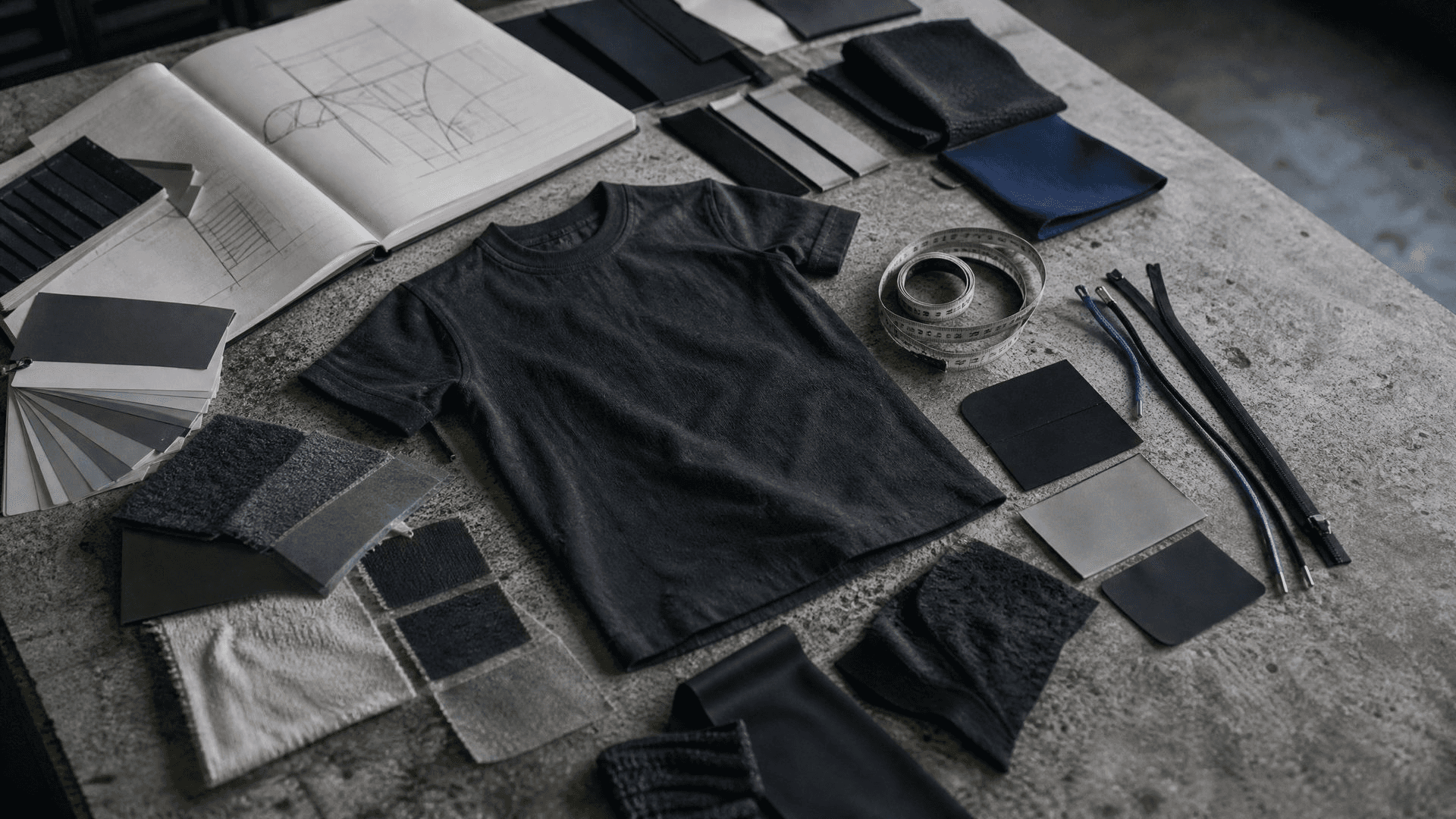
The Logo-and-Legging Trap is attractive because it feels fast. A supplement company has an audience. A coach has followers. A gym has members. Somebody decides apparel is the next obvious revenue stream, buys a few familiar blanks, adds the mark, and calls it a drop. The products arrive with no fit distinction, no color rules, no reason for the customer to choose the next version, and no underlying answer to why this line exists beside every other piece of training gear online.
The result is not necessarily bad apparel. It is apparel without a job. The hoodie is too generic to become a uniform. The legging has no tested support or recovery story. The tee carries too much graphic responsibility because its silhouette and hand feel carry none. Then the brand begins discounting, over-ordering, or asking the creative team to solve a development problem with another logo.
Darc Sport’s public product pages reveal the difference that deliberate blocks create. Its $50 Relentless Beast tee specifies tight-knit 100% cotton, sulfur wash, screen print, and cold-wash care. Its $70 Chambers hoodie specifies 100% cotton French terry, pre-shrinking, a dyed vintage finish, screen print, broad chest and sleeve proportion, true-to-size length, and its own care direction. Its $50 Everson Seamless bra identifies a nylon-spandex blend, engineered side-knit detail, heat transfer, adjustability, and fit guidance. These are three different products with three different technical needs. They do not deserve the same development brief.
The right move for a fitness brand is not to mimic Darc Sport’s wolf, price, wash, graphics, or posture. The right move is to copy the discipline. Give the core garment a purpose. Decide exactly what it needs to feel like. Build the technical platform around the athlete’s use case. Make the apparel recognizable even after you cover the logo.
From Community Identity to Product Specification
A great fitness brand has a visual code. The mistake is thinking that code starts and ends with graphic art. Visual identity becomes durable when it appears in the proportion of the tee, the weight and surface of the fleece, the repeatable color language, the way a bra holds its shape, and the consistency of the print after repeated wash and wear.
The oversized tee is a useful example. Darc Sport calls the Relentless Beast tee oversized and describes a tight-knit 100% cotton construction, a sulfur wash, and screen print. The finished garment creates an old-school, worn-in signal that belongs in the brand’s broader dark fitness vocabulary. A comparable fitness client needs to decide the practical version of that signal before bulk production begins. How oversized is oversized? Is the shoulder dropped? How does the neck rib recover? What shade variation is acceptable after washing? What happens to the print after ten cold washes? Which sizes receive the largest graphic? A good factory can manufacture the answer. A strong full-package partner helps define it.
The Chambers hoodie shows why silhouette language deserves the same discipline as a graphic. The product page specifies oversized chest and sleeves but true-to-size length. That is a tangible proportion choice. It shapes how a person trains in it, layers it, photographs it, and recognizes it on someone else. If your fitness brand asks for an “oversized hoodie” without defining the body length, sleeve volume, hood scale, pocket placement, rib recovery, shrinkage tolerance, and wash target, you have handed production the most important part of your product in vague language.
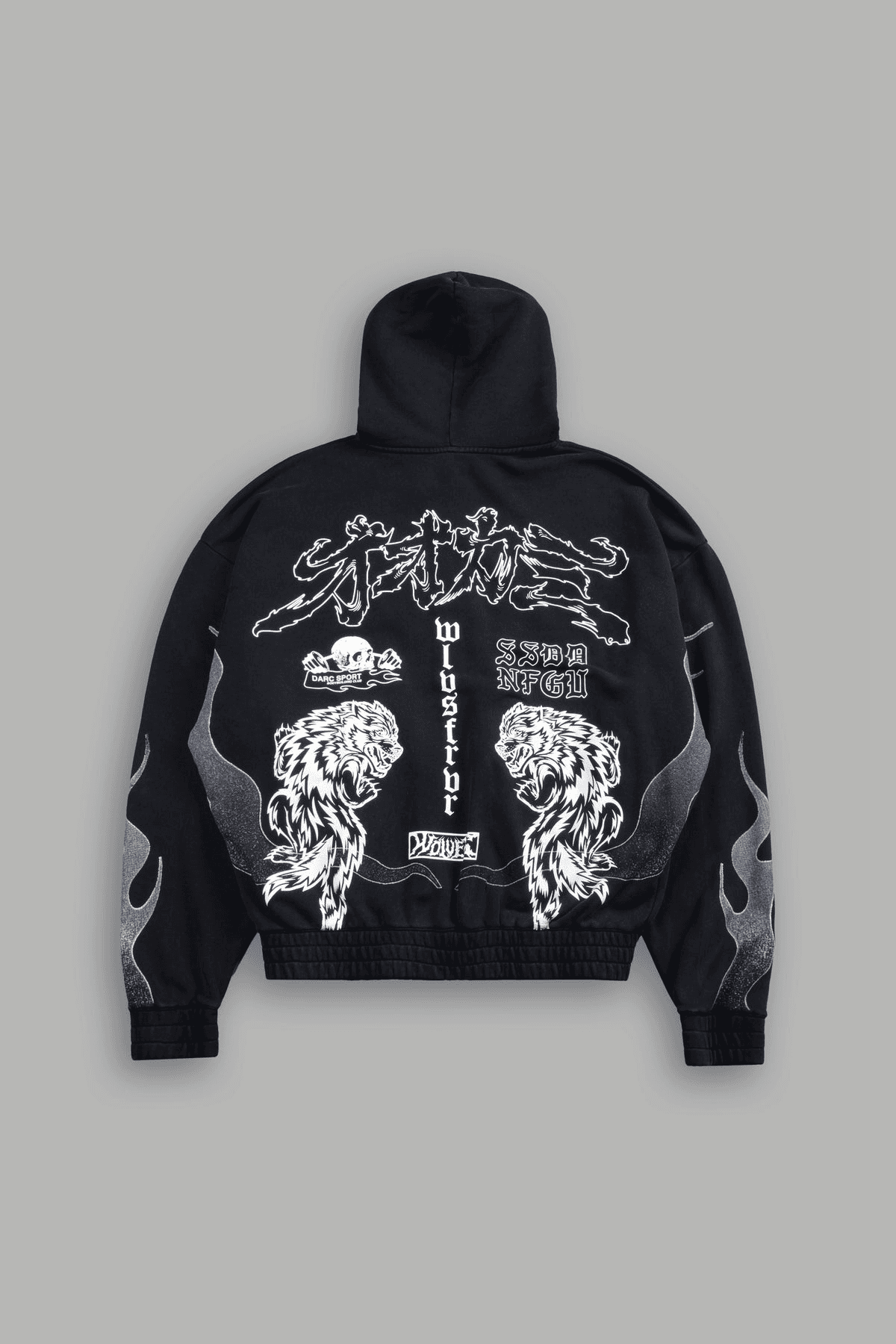
Darc Sport product image shown for editorial analysis. Source: Darc Sport, “Our Code Chambers Zip Hoodie in Black”, accessed August 28, 2026.
Technical women’s categories demand an even more explicit system. The Everson Seamless bra’s description includes nylon-spandex, engineered side-knit detail, heat transfer, adjustability, true-to-size language, and wash care. A comparable sports bra or legging program needs spec-level control across support, coverage, opacity under stretch, recovery, panel or knit placement, size grading, trim quality, and care performance. The brand cannot treat that work as a side project for the same supplier that prints its event tees. The customer notices the difference in the first workout.
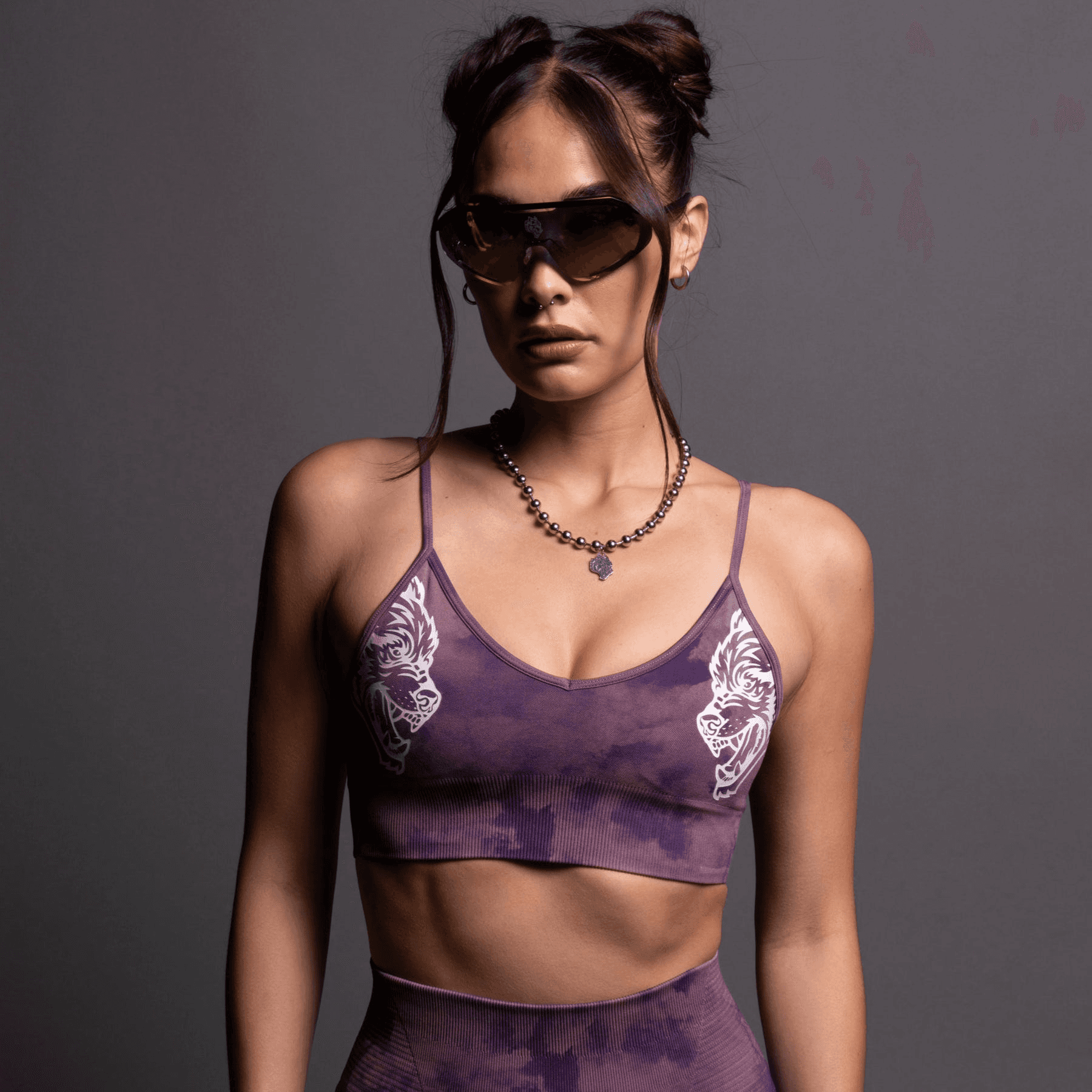
Darc Sport product image shown for editorial analysis. Source: Darc Sport, “Dual Wolf Everson Seamless Sports Bra in Purple Sky”, accessed August 28, 2026.
What It Takes to Build Fitness Apparel at Scale
The product system that works for a first drop often breaks when the business grows. Colors begin to vary between replenishments. Fit feedback gets trapped in email threads. Art scales incorrectly across sizes. A vintage treatment becomes inconsistent from one production batch to the next. A bra feels different in a new lot, and the brand cannot explain why. These are not creative failures. They are development and quality-control failures.
A full-package fitness-apparel workflow starts by defining four platforms before the product calendar becomes too wide: a core cotton training tee, an outer or fleece layer, a training-bottom block, and a technical women’s platform where relevant. Each platform should have an approved measurement spec, grade rules, material standard, trim specification, decoration rules, color references, care approach, and final pre-production sample. That library becomes the control system for every future release.
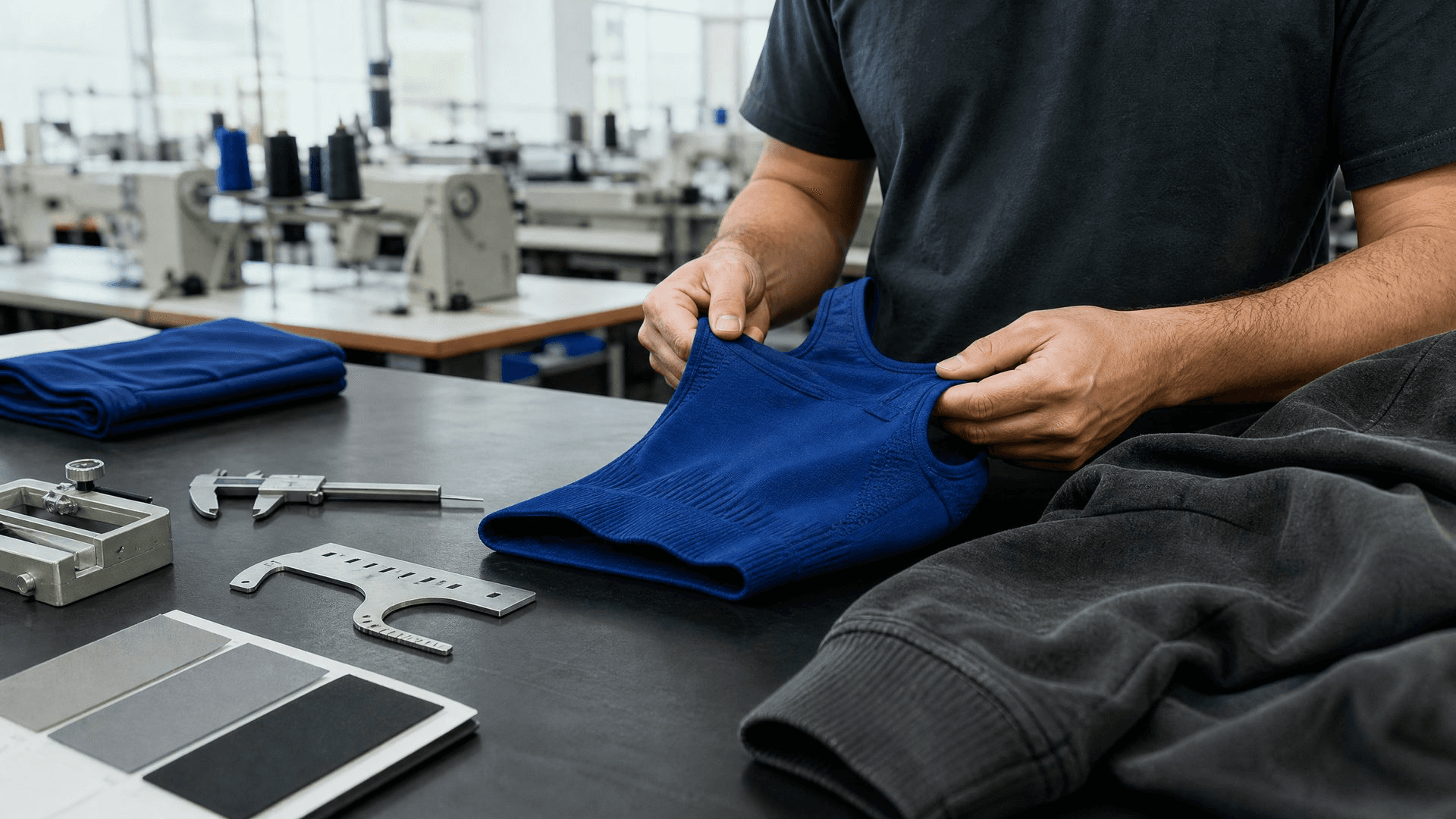
The testing priorities change with the category. Cotton lifestyle product requires attention to shrinkage, wash appearance, color change, print hand feel, and neck or rib recovery. French-terry fleece needs consistent hand feel, wash effect, size stability, zipper function when applicable, and quality control at the pocket, hood, rib, and seam intersections. Technical nylon-spandex product demands fit approval on the intended customer, stretch and recovery assessment, opacity review, stitch or knit integrity, heat-transfer adhesion, and wash performance. The buyer does not care which department missed the handoff. The buyer only knows whether the garment works.
Darc Sport’s live catalog also illustrates a merchandising principle that fitness founders frequently miss. A wide collection does not need to read like product sprawl if every item has a role. The men’s and women’s catalogs create room for training basics, expressive fashion crossover, licensed moments, and accessories. Fighters Den uses a themed architecture that moves from tees to muscle tees, raw-hem cuts, fleece, bags, and collector sets. The pieces are different, but the customer sees one world. That is the standard: build an assortment that feels like an argument, not a warehouse.
The Marketing System: How Product Turns Into Meaning
Product creates the proof. Marketing gives that proof a reason to travel. Darc Sport’s first-party pages put the community vocabulary right at the center, directing customers to drops, athletes, training content, and an inside look at the Wolves. Its story archive retains the narrative markers of past releases, helping customers see each current collection as part of a continuing sequence rather than a disposable campaign.
This is a stronger strategy than asking creators to make a generic product feel important after it arrives. If the brand has a real product block, a defined customer behavior, and a shared belief, athlete and creator content can amplify something the customer already recognizes. The content is not the whole story. It is evidence that the story is lived.
The Pacsun partnership shows a related commercial lesson. In July 2026, Pacsun announced itself as Darc Sport’s first retail partner and introduced a 48-piece Darc Sport Athletics collection for a nationwide select-store and online rollout. The partner announcement describes a product mix that crossed cotton jersey, French terry, polyester-spandex performance fabric, and bamboo nylon, spanning both men’s and women’s categories. The strategic point is not that every fitness brand should chase retail. It is that distribution expansion only works when the brand can edit itself into a clear, coherent assortment.
For a growth-stage fitness, functional-beverage, supplement, sports, or athlete-led brand, that means apparel needs its own product calendar and launch function. Establish the core uniform. Define the annual big moments, such as a race, launch, training camp, championship, retail activation, or customer gathering. Build a limited release around a real cultural reason. Then preserve enough core product that a customer discovering the brand after the moment can still buy into the system.
The HH Take: The Fitness Brand Needs a Product Department Before It Needs Another Vendor
The fitness companies with the strongest apparel opportunity are not necessarily trying to become apparel companies. They are already building community around training, performance, flavor, competition, coaching, endurance, recovery, or a creator’s point of view. The apparel exists to make that community physically visible. Yet most of these brands do not have an internal team that can own silhouette, fabric, color, art engineering, sampling, fit approval, factory coordination, quality control, and launch-ready delivery.
That is where a full-package goods supplier belongs. HH helps the fitness brand turn a community signal into a product system. The work begins with what the customer actually wears and why. Then it moves through design direction, product architecture, custom development, sampling, decoration engineering, approvals, bulk production, and delivery planning. The standard is not a cheap vendor quote or an overbuilt fashion experiment. The standard is an apparel line that feels like it belongs to the brand before the customer reads the logo.
A strong starting brief for a fitness client has four questions. What is the community’s actual uniform today? Which two or three garments deserve the highest development investment? Which product moments should remain limited, and which should become durable replenishment platforms? What visual and physical details would make this line impossible to confuse with event merch? If you cannot answer those questions, you are not ready for a catalog. You are ready for product strategy.
Conclusion: Build the Uniform Before You Build the Drop
Darc Sport’s real lesson is not that a fitness brand needs a wolf, a black tee, or a louder slogan. Its lesson is that community becomes commercially durable when product, culture, and repetition tell the same story. The word NFGU works because it is carried by an entire brand world, from a repeatable gym silhouette to named release chapters, athlete content, technical women’s product, and retail expansion.
Your fitness audience already has a language. It has rituals, reference points, gear preferences, shared frustrations, and a reason it shows up. The product becomes valuable when it gives that audience something it would choose to wear even if the purchase was not a show of support. Build that uniform with the same care you put into your formula, your programming, your events, or your athlete roster.
If you are ready to turn a training community, launch, sport, or brand movement into a full apparel system, bring HH the moment you are building. We will help you define the product that makes the moment last.
Frequently Asked Questions
How do you make fitness merchandise feel like a real apparel brand?
Make fitness merchandise feel like a real apparel brand by developing repeatable fit and material platforms before creating a large graphic calendar. A signature tee, tested fleece block, training short, and technical women’s platform give customers a reason to trust the next release. Then your color, graphic, athlete, and campaign work can add meaning to a product they already want to wear.
What products should a fitness brand launch first?
A fitness brand should begin with the two to four garments that match its community’s real routine, not a broad catalog. A cotton training tee or pump cover, fleece layer, training short, and one properly developed women’s performance platform are a practical opening system. Every product needs a defined fit, fabric, decoration, and quality standard before you chase category breadth.
What is a pump-cover T-shirt, and why does it work for gym brands?
A pump-cover T-shirt is a loose, usually heavyweight or substantial-feeling training tee worn before, during, or after a workout. It works because it feels natural inside gym culture while also functioning as a casual lifestyle layer. The business value comes from making the fit, hand feel, neckline, wash, and graphic treatment recognizable enough to become the community’s preferred uniform.
When should a fitness brand use custom development instead of standard blanks?
Use custom development when fit, fabric hand, wash, finish, or technical function is central to why the customer will buy again. Standard blanks suit fast event product and low-risk tests, but they limit your ability to own a signature oversized tee, fleece silhouette, training bottom, seamless bra, or long-term product platform. The customer should feel the difference before they read the logo.
How do you develop a seamless sports-bra or legging collection?
Develop a seamless sports-bra or legging collection by starting with a defined use case, support expectation, size range, and fit model, then validating material recovery, opacity under stretch, comfort, heat-transfer or logo adhesion, and wash performance. Treat the design as a technical product, not a women’s version of the men’s graphic program. The specification, sample approval, and quality-control process must reflect that reality.
What needs to be tested before manufacturing fitness apparel
Test the factors that determine whether the garment survives real use: fit, grading, shrinkage, wash appearance, color consistency, screen-print durability, stretch recovery, opacity, trim function, and seam or knit integrity. The exact protocol changes with cotton, fleece, and technical performance fabrics. Your production partner should turn those requirements into written approval gates before bulk production starts.
How do fitness brands build a repeatable apparel drop model?
Fitness brands build a repeatable drop model by protecting a stable core product platform while giving each limited release a real story, event, athlete moment, or customer behavior to serve. The customer returns for new meaning but trusts the fit and product language. A calendar built only on novelty creates fatigue; a calendar built on a recognizable uniform and carefully chosen moments builds habit.
What does a full-package fitness apparel partner manage?
A full-package fitness apparel partner manages the work between the initial idea and bulk-ready product: assortment strategy, garment design, fabrics, colors, trims, tech packs, sample development, decoration engineering, fit approvals, factory coordination, production quality control, and launch delivery planning. This gives a fitness, supplement, sports, or creator brand a product function without forcing its internal marketing team to become an apparel operations department.