The Private Label Playbook: How to Launch a Profitable Store Brand with No Apparel Experience
The Private Label Playbook: How to Launch a Profitable Store Brand with No Apparel Experience
3 MINUTES
February 26, 2026
For years, you have curated the perfect collection of brands for your customers. You have built a loyal following that trusts your taste and point of view. But as you look at your sales data, a clear pattern emerges: your best-selling items are often the most basic, the timeless essentials that your customers buy again and again. And with every sale of another brand’s product, you are building their equity, not your own. What if you could capture that value for yourself? What if you could launch your own private label line, offering your customers the quality they expect, but with the margins and brand control you have always wanted?
For most retailers, the idea of launching a private label clothing line feels overwhelming. The world of apparel manufacturing is notoriously complex, filled with technical jargon, opaque pricing, and a seemingly endless list of potential pitfalls. Without an internal design team or production department, the entire endeavor can feel like a non-starter. But what if there was a way to access the benefits of a private label program—higher margins, complete brand control, and increased customer loyalty—without taking on the operational burden of becoming an apparel company?
This is the private label playbook. It is a guide for retailers, boutique owners, and e-commerce entrepreneurs on how to launch a profitable store brand by leveraging a full-package manufacturing partner. We will break down the business case, the product strategy, the financial model, and the step-by-step process for bringing your brand to life, proving that you do not need to be an apparel expert to build a successful apparel brand.
The Business Case: Why Private Label is the Ultimate Retail Moat
In a competitive retail landscape, a private label brand is one of the few sustainable moats you can build around your business. It offers three distinct advantages that third-party brands simply cannot match: margin, brand, and loyalty.
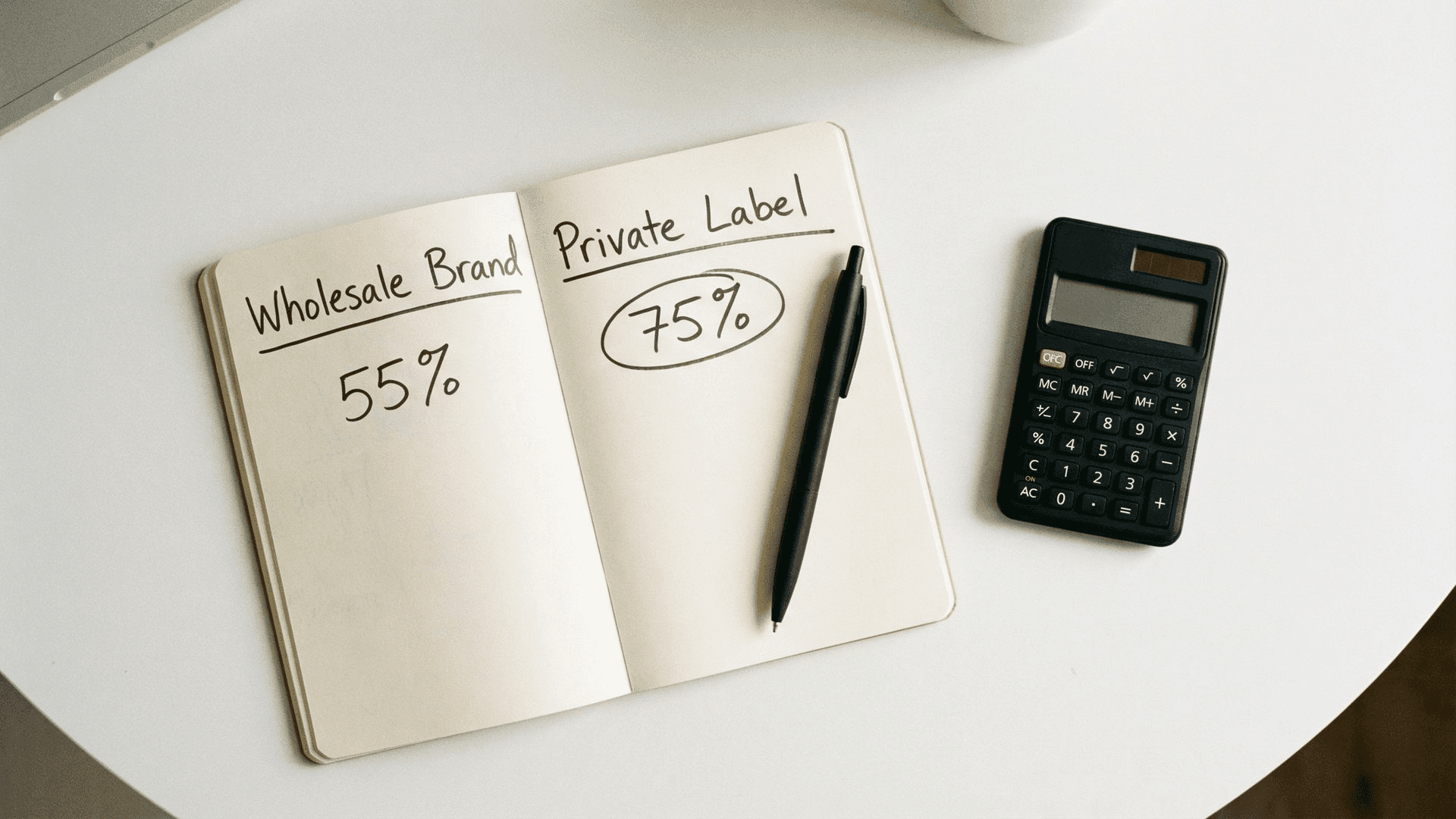
Margin Expansion: This is the most immediate and tangible benefit. While a typical wholesale relationship might yield a 50-60% gross margin, a private label program can deliver margins of 70-80% or even higher. By going directly to the source, you eliminate the brand markup, capturing that value for your own bottom line. On a $100,000 investment in inventory, that is a $20,000 difference in gross profit—a significant injection of capital that can be reinvested into marketing, growth, or simply taken as profit.
Brand Differentiation: Your private label is the ultimate expression of your store’s unique point of view. It is a product that your customers cannot find anywhere else, creating a powerful reason for them to shop with you and only you. It allows you to fill gaps in the market, offering the specific styles, fits, and colors that you know your customers are looking for but cannot find from existing brands. In a world of infinite choice, a unique and desirable product is the ultimate differentiator.
Customer Loyalty: When a customer buys your private label product and loves it, they are not just buying a piece of clothing; they are buying into your brand. Their loyalty is to you, not to a third-party brand that you happen to carry. This creates a powerful feedback loop: the more they wear and enjoy your product, the more they trust your curation and the more likely they are to become a lifelong customer. A successful private label program transforms your store from a transactional marketplace into a trusted brand in its own right.
The Product Strategy: Start with the Essentials
The key to a successful private label launch is to start with a tightly curated collection of essential, evergreen products. This is not the time to take a risk on a trendy, seasonal item. Instead, focus on the timeless basics that you know your customers already love and buy frequently. Think premium heavyweight tees, perfectly cut hoodies, classic crewneck sweatshirts, and essential accessories like beanies and caps. These are the foundational pieces of any wardrobe, and they are the products where quality and fit matter most.
By focusing on essentials, you de-risk your initial investment in several ways. First, these products have a much longer shelf life than trend-driven items, reducing the risk of markdowns and deadstock. Second, they are easier to get right from a design and production standpoint, allowing you to focus on perfecting the quality and fit without being distracted by complex construction. Finally, they provide a clear and compelling value proposition to your customers: a better version of the basics they already love, at a price that is often more accessible than the big-name brands.
Your initial collection should be small and focused, no more than three to five core styles. For each style, offer a tight range of two to three essential colors, such as black, white, and a neutral grey or stone. The goal is not to offer infinite choice, but to offer the right choice. A small, perfectly executed collection will always outperform a large, mediocre one.
The Financial Model: Understanding the Numbers
A common misconception about private label is that it requires a massive upfront investment. While it is true that you will be investing in inventory, the numbers are often more manageable than you might think, especially when working with a partner who offers reasonable minimum order quantities (MOQs).
Let’s break down a hypothetical first order for a premium heavyweight tee:
Cost Component | Per Unit | Total (300 Units) |
Landed Cost (incl. freight) | $15.00 | $4,500 |
Retail Price | $50.00 | $15,000 |
Gross Margin | 70% | $10,500 |
In this scenario, a $4,500 investment generates $10,500 in gross profit once the inventory is sold through. Now, imagine launching with a small collection of three essential styles: a tee, a hoodie, and a cap. Your total initial investment might be in the range of $15,000 to $25,000, with a potential return of $35,000 to $60,000. This is a powerful financial engine for a small business. The key is to work with a manufacturing partner who can accommodate MOQs of 200-300 units per style, allowing you to test the market without tying up excessive capital in inventory.
The Partnership Model: Finding Your Full-Package Partner
The single most important decision you will make in this process is not what product to make, but who to make it with. For a retailer with no internal apparel team, a full-package manufacturing partner is the only viable path forward. A full-package partner handles the entire process from end to end, acting as your outsourced design, development, and production team. Their role is to translate your brand vision into a finished, market-ready product.
A true full-package partner provides a comprehensive suite of services:
•Product Strategy & Design: They work with you to refine your product assortment, develop custom silhouettes, and create a cohesive collection that reflects your brand’s unique identity.
•Material Sourcing & Development: They have deep relationships with fabric mills and trim suppliers around the world, allowing them to source the perfect materials for your product, from heavyweight organic cotton to technical performance fabrics.
•Technical Design & Sampling: They create detailed tech packs, patterns, and prototypes, managing the entire sampling process to ensure that the final product meets your exact specifications for fit and quality.
•Production Management & Quality Control: They manage the entire production process, from factory allocation to inline quality control, ensuring that your standards are met at every stage of manufacturing.
•Logistics & Delivery: They handle all freight, customs, and logistics, delivering finished, retail-ready product directly to your door.
Working with a full-package partner de-risks the entire process. They provide the expertise, infrastructure, and accountability that you need to launch a professional-grade product without the overhead of an internal team. They are not just a vendor; they are a strategic partner invested in your success.
Ready to explore a private label program for your store? Download our free Private Label Launch Guide to learn how to build a profitable store brand from scratch.
Conclusion: Your Brand, Your Equity
Launching a private label brand is a transformative step for any retailer. It is the moment you transition from being a curator of other people’s brands to the owner of your own. It is a declaration of your unique point of view and a commitment to building a long-term asset that you control completely. While the process may seem complex from the outside, the path forward is clear: start with a focused collection of essentials, understand the financial model, and find a full-package partner who can execute your vision flawlessly. By building your own brand, you are not just building a product; you are building equity, loyalty, and a sustainable competitive advantage that will power your business for years to come.
FAQ: Launching a Private Label Clothing Line
What is a realistic budget to start a private label clothing line?
A realistic starting budget is typically between $15,000 and $25,000. This covers the initial product development, sampling, and the first production run for a small, focused collection of 2-3 core styles.
What are typical minimum order quantities (MOQs) for private label?
While some factories require thousands of units, a good full-package partner can often work with MOQs as low as 200-300 units per style, per color. This allows you to launch with a manageable inventory investment.
How long does it take to launch a private label line?
From initial concept to receiving your first production run, a typical timeline is four to six months. This includes 4-6 weeks for design and development, 4-6 weeks for sampling and revisions, and 8-12 weeks for bulk production and delivery.
Do I need to be a designer to start a private label?
No. A good full-package partner has an in-house design and development team that can translate your ideas, mood boards, and reference samples into a professional, market-ready product. Your role is to provide the brand vision; their role is to handle the technical execution.
How do I find a reliable manufacturing partner?
Look for partners with a proven track record of working with brands at your scale. Ask for case studies and client references. A reliable partner will be transparent about their process, pricing, and capabilities. They should feel like a strategic advisor, not just a factory.